Now01
Manual production
A transportable line that standardizes envelope and window work near the jobsite.
Commercialize the process first
BRYTEK turns wall panels into installation-ready envelope assemblies in a portable production system—bringing factory control to the project, without moving the project to a factory.
By completing envelope work while the structure is still being assembled.
THE JOBSITE ISN'T THE PROBLEM.
Exterior work usually begins after framing. BRYTEK starts it before installation—turning a serial schedule into a parallel one.
A look at the housing pressure
driving better building systems.
Real panels. Real installation.
Watch the work take shape.
A compact, transportable production line processes vertical wall panels close to the site. Each step is visible, repeatable and designed around how the building will actually be assembled.
Panels arrive from the framing line and move directly into a controlled, upright production flow.
Five steps. One continuous process.
Conceptual process illustration. Future automation is shown for context; the roadmap below distinguishes current work from planned capabilities.
BRYTEK is built around one operational change: start the building envelope while framing is still moving—not months after it begins.
Scroll sideways on smaller screens to read every stage, or open the full-size chart.
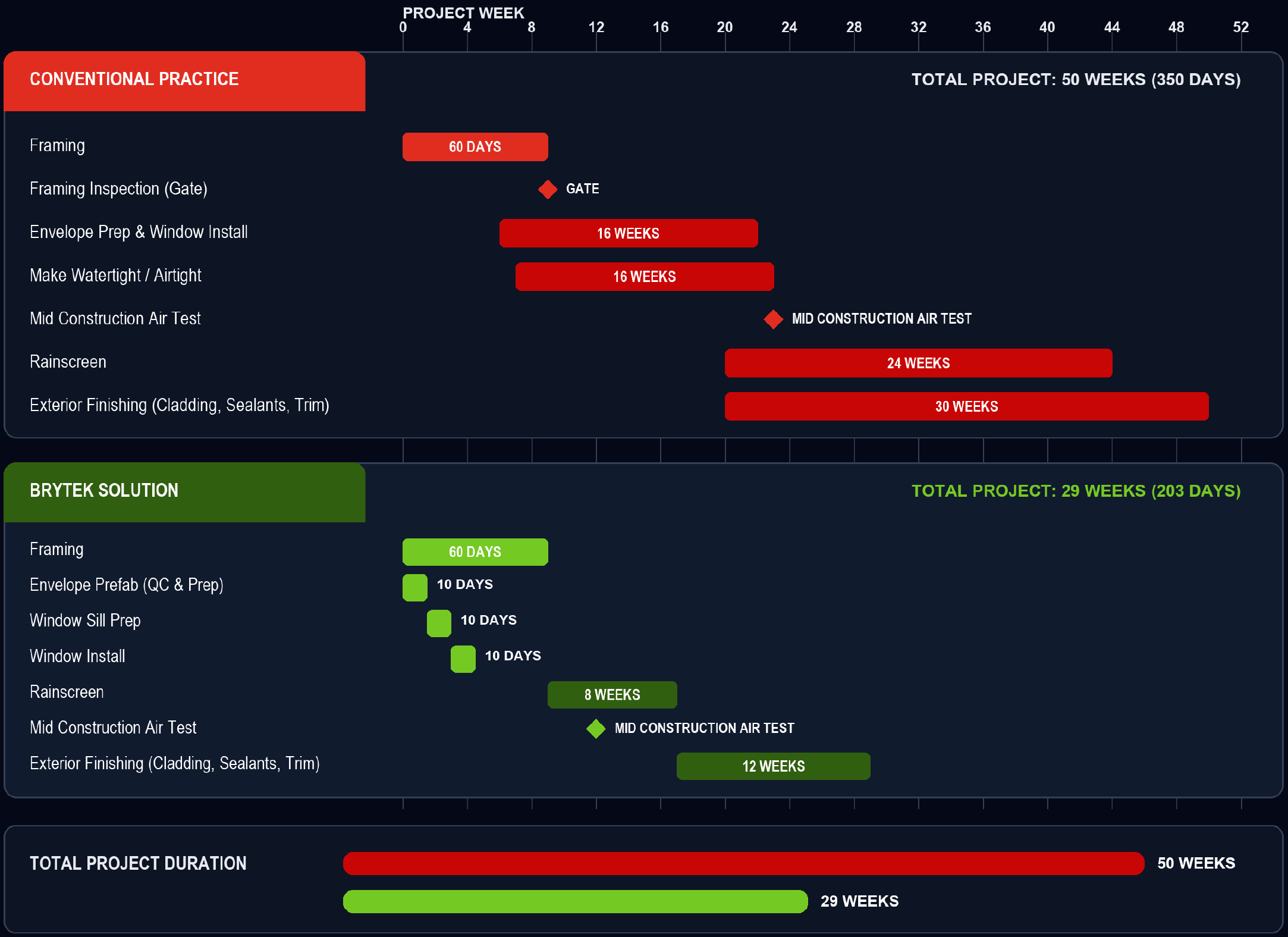
Source: BRYTEK MMC Innovation Update, July 21, 2026, page 3. Original chart preserved. Illustrative six-storey schedule; full-building validation pending. This is not the confirmed programme for the current four-storey pilot.
View full-size chartSchedule compression to be demonstrated through a full-scale multi-family pilot.
Output achieved in the early two-person manual prototype trial.
Final whole-building airtightness at 330 Goldstream, achieved by the project team. Read the documented history.
BRYTEK traces its roots to the envelope work at 330 Goldstream Avenue in Colwood. Before the portable production cell, there was a real project—and the practical challenge of moving envelope work earlier.
BC Housing documents Brytar Contracting working with Kinetic Construction and the prefabrication team. At ZyTech’s yard, panels were inspected, Brytar applied the sheathing membrane, and assemblies were repacked in installation order. The work moved upstream, before delivery to site.
Bulletin 4 · pp. 2–5The envelope substantial-completion test achieved 0.44 ACH50 against a 0.60 target. The result established a measured performance milestone before exterior insulation and cladding proceeded.
Bulletin 3 · p. 11The final blower-door test recorded 0.55 ACH50, still below the project’s 0.60 target. This was a whole-building result delivered by the coordinated project team.
Bulletin 3 · pp. 2, 11BRYTEK’s direction builds on that experience: bring controlled envelope production closer to the project, integrate windows and quality records, then develop automation around a repeatable workflow.
Bulletin 4 also records weather exposure, transport and storage constraints, and panel-alignment issues requiring repairs. It stresses early coordination and quality control. These challenges help explain BRYTEK’s focus on near-site production and verification.
Read the prefabrication research · pp. 7–9The BC Housing bulletins document the Goldstream project and Brytar’s contribution; the connection to BRYTEK is our company’s development story. These publications do not establish BC Housing endorsement of BRYTEK or validate its current schedule-reduction targets.
The manual system creates value immediately. Computer vision and robotics build on a process that has already been designed, timed and tested in the field.
A transportable line that standardizes envelope and window work near the jobsite.
Computer vision verifies geometry, installation and workmanship as every panel moves through.
Automate membrane application to increase output while preserving a repeatable quality standard.
Images, dimensions, tolerances and installation evidence become one structured file—from factory position to building position.
BRYTEK is structuring a 60-unit, four-storey rental pilot in Greater Victoria to validate the complete commercial thesis: output, quality, schedule and cost.